10 Best PCR and qPCR Machines for Global Buyers?
PCR and qPCR platforms now support clinical testing, food safety, environmental monitoring, and academic research worldwide. Demand is rising, but market estimates differ. MarketsandMarkets’ 2024 PCR market report projects strong growth through 2029, driven by infectious-disease testing, precision medicine, and molecular diagnostics. Grand View Research also identifies real-time PCR as a major technology segment.
The numbers are persuasive. The purchasing decision is not simple.
This guide compares 10 PCR and qPCR machines for global buyers. It examines thermal accuracy, ramp speed, optical channels, multiplex capacity, software usability, service coverage, and total ownership cost. A 96-well plate may look similar across brands, yet block uniformity can affect edge wells, controls, and low-copy targets. Firmware support matters too. So do local voltage requirements, consumable availability, installation training, and regulatory status.
Stephen A. Bustin, a leading qPCR methodology authority and contributor to MIQE guidance, has stated, “qPCR is a powerful technique, but it is also a complex technique.” That warning deserves attention. A fast instrument cannot rescue weak primers, poor calibration, or inconsistent pipetting.
Real laboratory experience often challenges brochure claims. A machine with impressive throughput may require expensive proprietary plastics. A compact system may simplify field testing but limit multiplex workflows. No ranking is perfect. Not always.
Our selection balances published specifications, laboratory practicality, vendor reputation, and independent market evidence. Buyers should still verify regional support, validation requirements, and application compatibility before purchase. These ten systems offer a practical starting point for comparing pcr e qpcr performance across different budgets and laboratory environments.
PCR and qPCR Machines: Core Technologies and Key Differences
PCR and qPCR Machines: Core Technologies and Key Differences
PCR and qPCR machines share the same foundation: precise heating and cooling of reaction tubes. Their thermal blocks control denaturation, primer binding, and extension cycles. A conventional PCR machine usually reveals results at the end, often through gel electrophoresis. This approach is practical for presence-or-absence testing, but it adds handling steps and increases contamination risk.
qPCR machines add an optical detection system. Fluorescent signals are measured during every cycle, allowing users to monitor amplification in real time. The resulting Cq or Ct value can support relative or absolute quantification. Reliable interpretation depends on standard curves, reference genes, amplification efficiency, and clean controls. A low Cq value does not automatically mean a higher biological level. Sample quality still matters.
Global buyers should examine block uniformity, temperature accuracy, optical channels, software controls, and data export formats. Multiplex experiments need well-separated fluorescence channels and careful compensation settings. Service access also deserves attention. A machine with excellent specifications may become inefficient when calibration takes months. Faster cycling sounds attractive, yet rushed temperature transitions can undermine reproducibility. Small details matter: heated-lid pressure, plate sealing, compatible consumables, and local voltage requirements. I would also challenge one common assumption. More channels do not always improve a laboratory; unused channels can increase cost and training demands. Validation with known standards and representative samples remains essential before routine deployment.
How to Evaluate PCR and qPCR Systems for Laboratory Needs
Selecting a PCR or qPCR system requires more than comparing prices and maximum sample numbers. A 2024 Fortune Business Insights report valued the global PCR market at about US$10.9 billion in 2023. That growth reflects wider testing needs, but market size does not prove instrument suitability. Laboratory managers should match block capacity with daily workload, not occasional peak demand.
Check thermal uniformity, ramp speed, optical channels, and fluorescence sensitivity. These features affect weak targets and multiplex reactions. A practical evaluation uses identical samples across several wells. Inspect Cq variation, failed runs, evaporation, and calibration records. The MIQE guidelines also emphasize controls, assay efficiency, and transparent reporting. Software matters too. Can analysts review raw curves easily?
Service quality deserves equal attention.
Ask about installation training, preventive maintenance, spare parts, data export, and response times in your region. Read independent validation studies, not only supplier specifications. Total ownership cost includes reagents, plastics, calibration, and downtime. I would not trust a machine after one impressive demonstration. A short trial is better. Still, even trials can mislead when operators are unusually careful. Document normal workflow conditions, including rushed loading and mixed user experience. That imperfect evidence may reveal the system your laboratory can actually manage.
Ten Leading PCR and qPCR Machines for Global Buyers
Ten Leading PCR and qPCR Machines for Global Buyers
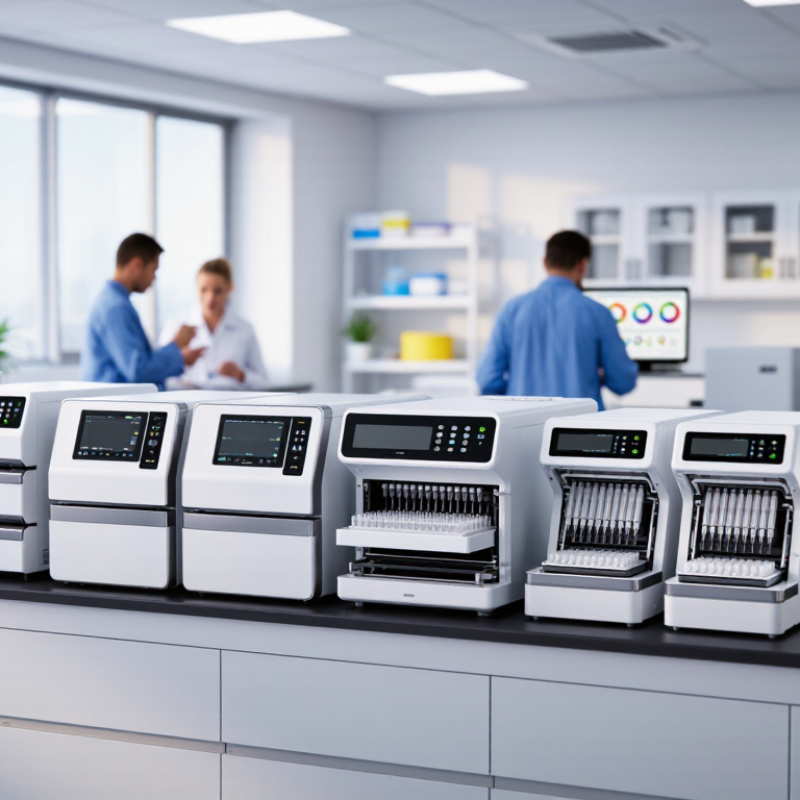
The ten leading PCR and qPCR machines serve different laboratory realities.
A 96-well conventional PCR system suits routine amplification and teaching laboratories.
A 96-well qPCR system adds fluorescence-based quantification for gene expression and pathogen research.
A 384-well qPCR platform supports larger studies but requires careful pipetting.
Fast-cycling systems reduce waiting time during busy workflows.
Gradient PCR instruments help optimize annealing temperatures across multiple samples.
Portable PCR units support field testing where bench space and power are limited.
Compact qPCR systems fit smaller laboratories with moderate sample volumes.
High-throughput platforms improve consistency in screening programs.
Multiplex qPCR machines detect several targets in one reaction.
Digital PCR systems offer highly sensitive measurement, although their costs and workflow demands are higher.
Practical evaluations should examine thermal uniformity, optical channels, software clarity, and maintenance access.
A reliable machine should produce stable results across repeated runs.
It should also support local voltage standards and available service networks.
Open consumable compatibility may lower long-term costs.
However, open systems can increase method-development responsibility.
That trade-off is easy to underestimate.
No universal winner exists.
Tips:
Request raw performance data, not only marketing claims.
Test your own primers, probes, and sample types before purchase.
Check calibration records and temperature verification procedures.
Confirm data export formats for your laboratory software.
Ask about training, spare parts, and response times.
A cheaper instrument may become expensive when support is distant.
Also, remember that operator technique can distort excellent hardware results.
Comparing Performance, Features, Costs, and Applications
Choosing among the 10 best PCR and qPCR machines requires more than comparing purchase prices. In daily laboratory work, thermal uniformity often matters more than impressive ramp speed. A reliable instrument should maintain consistent temperatures across every well, especially during low-copy assays. Fast cycling helps busy laboratories, but excessive speed can reduce flexibility. This trade-off deserves careful validation.
Key features include gradient control, fluorescence channels, multiplex capacity, and compatibility with common 96-well or 384-well plates. Clear software also matters. Operators should adjust protocols, export raw data, and review amplification curves without unnecessary steps. For qPCR, optical sensitivity and baseline correction directly affect quantification quality. Routine calibration and documented maintenance support dependable results. Small details matter, such as heated-lid stability and easy-to-clean surfaces.
Costs extend beyond the initial quotation. Buyers should assess consumables, service contracts, training, software fees, and regional technical support. A lower-priced system may become expensive when replacement parts are difficult to obtain. Conversely, advanced features may remain unused in a teaching laboratory. Clinical testing, food analysis, environmental monitoring, and research projects require different priorities. In my experience, side-by-side testing with control templates reveals weaknesses that brochures rarely mention. No instrument is perfect. Users should question published performance data, confirm local compliance requirements, and request application-specific demonstrations before purchasing.
PCR and qPCR Platform Benchmark
This comparison uses representative published specification ranges for commonly available PCR and qPCR platform categories. Higher well capacity supports greater throughput, while shorter run time improves turnaround. Optical channel counts indicate approximate multiplexing capability and can vary by assay chemistry and configuration.
How to Select, Purchase, and Maintain the Right Machine
Choosing among ten capable PCR and qPCR machines starts with workflow, not advertised speed. Define sample volume, throughput, dye compatibility, multiplex needs, and temperature uniformity. A compact system may suit a teaching lab, while a 96-well platform fits daily research. Check validation records, calibration intervals, software audit trails, and local service coverage. Ask for raw performance data, not only brochure claims.
Before purchasing, calculate the full cost over five years. Include installation, training, calibration, replacement blocks, software licenses, and downtime. Request a live demonstration using your own plate format and representative assay. Confirm electrical requirements, delivery conditions, warranty terms, and technical support response times. Do not overlook data export. It can hurt later. Procurement teams should compare at least three written quotations. Record why one system fits the protocol best.
Maintenance is less glamorous, but it protects results. Keep the block clean, inspect seals, use certified consumables, and follow the maintenance schedule. Run controls and trend amplification curves after service or software changes. Store calibration certificates with instrument records. Records matter. A failed negative control should pause the run, not invite excuses. One practical caution remains: the “best” machine can disappoint when users skip training or overload the schedule. Reassess performance quarterly, because real workloads rarely match the original purchase plan.