China Best Barley Grass Juice Powder Manufacturer?
Choosing the China Best barley grass juice powder Manufacturer requires more than comparing price lists. It requires evidence.
The global dietary supplements market was valued at approximately USD 177.5 billion in 2023, according to Grand View Research. Its report also identifies growing demand for plant-based and convenient nutrition formats. Meanwhile, Future Market Insights reports continued expansion in greens supplements, supported by powdered products with longer shelf stability. These figures describe broader categories, not barley grass alone. That distinction matters.
A reliable Barley Grass Juice Powder manufacturer should explain each production stage clearly. Fresh barley grass should be harvested at a controlled growth stage. Juice extraction, filtration, concentration, and low-temperature drying can affect color, flavor, and nutrient retention. Ask for batch records, origin documentation, and a current certificate of analysis. Testing should cover moisture, microbiology, pesticides, heavy metals, and identity.
Look for practical proof. Can the supplier provide a small sample, factory audit support, and stable specifications across batches? Certifications such as ISO 22000, HACCP, or organic approval may strengthen supplier evaluation, but certificates must be verified. A bright green powder is not enough. Marketing language is not laboratory evidence.
China has many capable botanical ingredient producers. Quality still varies widely. Some suppliers may describe “juice powder” without explaining the actual juice-to-powder process. That point deserves careful questioning. The best partner combines processing experience, transparent documentation, responsive communication, and realistic claims. No manufacturer should promise medical effects without appropriate scientific and regulatory support. In this guide, we examine how to compare Chinese manufacturers using measurable quality, compliance, and supply-chain criteria.
What Is Barley Grass Juice Powder?
Barley grass juice powder comes from young barley leaves harvested before grain formation. The leaves are washed, crushed, and pressed to release their green juice. After filtration, the liquid is gently dried into a fine powder. This process differs from ordinary barley grass powder, which usually contains the whole dried leaf.
Its color is often bright green, while its flavor can be earthy, grassy, and slightly bitter. Water temperature matters. Very hot water may affect some sensitive nutrients and make the taste harsher. Many people mix it with cool water, smoothies, or fresh juice. It can provide chlorophyll, minerals, and plant compounds, but its nutritional value varies with soil, harvest timing, processing, and storage.
It is not a magic solution.
Reliable quality requires more than attractive color. A professional manufacturer should verify botanical identity and test each batch for moisture, microbial limits, heavy metals, and pesticide residues.
Traceability should connect the finished powder to its farm and production date. Packaging also matters because oxygen, light, and humidity can reduce freshness. Some powders dissolve smoothly, while others leave sediment. That difference may reflect filtration rather than poor quality.
Consumers with allergies, medication concerns, or special dietary needs should check the product specifications with a qualified professional. Research on barley grass is promising in some areas, but human evidence remains limited, and stronger claims need careful restraint.
How Is Barley Grass Juice Powder Manufactured in China?
How Is Barley Grass Juice Powder Manufactured in China?
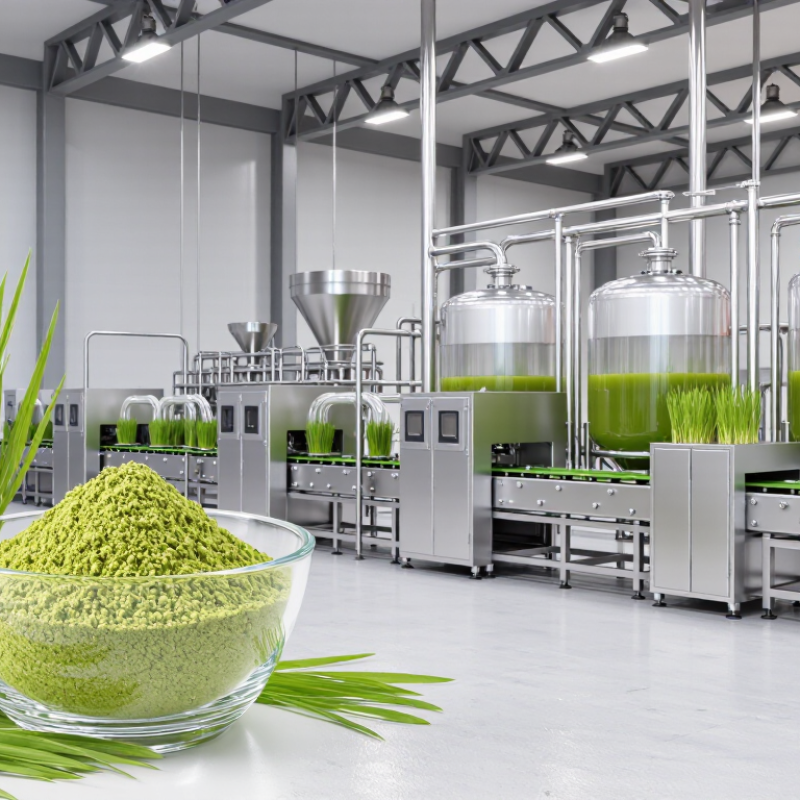
Barley grass juice powder is usually made from young barley leaves grown on controlled farms. Producers harvest the leaves before seed formation, when their color and moisture are carefully monitored. Fresh material is washed, inspected, and pressed to separate the juice from coarse plant fiber. The juice then passes through filtration to remove visible particles. It is commonly dried with spray drying or freeze-drying equipment. Spray drying is efficient, while freeze-drying may better protect heat-sensitive nutrients. The choice affects color, solubility, cost, and flavor.
Tips: Ask for batch records, farm information, and recent laboratory reports. Testing should cover moisture, microbial levels, heavy metals, pesticides, and identity. A reliable facility should explain its cleaning controls and traceability process clearly. Check how the powder is packed. Moisture-proof bags and controlled storage help prevent clumping and oxidation.
Quality is not created by machinery alone. Experienced workers must judge leaf freshness, filtration performance, and drying conditions. Some manufacturers may adjust processing temperatures after testing, rather than following one fixed formula. That sounds less convenient. It can be more realistic. Buyers should also compare color, aroma, dispersibility, and nutrition results between batches. A bright green powder is not automatic proof of superior quality. Independent verification remains valuable when product claims appear unusually strong.
What Makes a Chinese Manufacturer the Best Choice?
A Chinese barley grass juice powder manufacturer can be a strong choice because production experience often comes from close work with farmers, processors, and export markets. Many facilities source mature barley grass from controlled growing areas. They then wash, juice, filter, and dry it at low temperatures. This process helps protect color, flavor, and sensitive nutrients.
Professional manufacturing depends on more than modern equipment. A reliable supplier should provide batch records, ingredient traceability, and test reports from qualified laboratories. Tests may cover moisture, microbes, heavy metals, pesticides, and nutritional values. Clear specifications also reduce misunderstandings about powder color, solubility, packaging, and shelf life. Experienced teams can adjust production for capsules, drink mixes, or bulk food applications.
Communication matters in daily business. Chinese manufacturers often offer flexible quantities, packaging options, and production schedules. Yet “best” should never mean “cheapest.” A factory may show excellent documents but still respond slowly when problems appear. No supplier is flawless. Buyers should request samples, audit records, recent test results, and realistic lead times before ordering. A careful factory will welcome these questions, even when a few answers need improvement.
What Makes a Chinese Barley Grass Juice Powder Manufacturer a Strong Choice?
A practical 100-point buyer evaluation framework for comparing manufacturing partners.
The framework prioritizes the factors most relevant to powdered botanical products: food-safety systems, batch traceability, laboratory testing, raw-material control, processing consistency, export documentation, and production scalability. Buyers should verify each point through current certificates, test reports, audit records, and product samples rather than relying on claims alone.
How to Evaluate Quality, Safety, and Certifications?
China Best Barley Grass Juice Powder Manufacturer?
Quality starts with the raw material, not the package design. Ask where the barley grass was grown and when it was harvested. Fresh juice powder should show a natural green color, a clean grassy aroma, and fine, even particles. A dull brown appearance may suggest oxidation, poor drying, or extended storage. However, color alone proves very little.
Request a recent certificate of analysis for each production lot. It should cover moisture, microbial counts, yeast, mold, heavy metals, pesticide residues, and pathogens. The testing laboratory should be identifiable and appropriately accredited. Check the production date, lot number, sample method, and specification limits. A certificate without traceable details is weak evidence. Factory hygiene, allergen controls, sanitation records, and batch traceability also matter. Certifications such as GMP, HACCP, ISO 22000, or applicable organic standards can support confidence, but they do not replace independent testing. No single certificate answers every question.
Tips: Request a sealed sample before ordering. Compare its aroma after opening and after mixing in water. Ask whether additives, carriers, or artificial colors are used. Review storage conditions, packaging layers, and shelf-life data. If the supplier avoids specific answers, pause. A low price can look attractive, yet testing and traceability may be missing. My view is imperfect but practical: inspect documents, test samples, and question claims that sound too certain.
How to Select the Right Barley Grass Juice Powder Supplier?
How to Select the Right Barley Grass Juice Powder Supplier?
A reliable supplier should prove more than a bright green color. FAOSTAT recorded over 150 million tonnes of barley production globally in 2021, yet raw material scale does not guarantee juice quality. Ask where the barley was grown, when it was harvested, and how quickly it was processed. Juice powder should have clear specifications for moisture, chlorophyll, particle size, and solubility. A practical sample test matters. Mix five grams in water and check sediment, aroma, and consistency.
Traceability is essential. WHO estimates that contaminated food causes 600 million illnesses worldwide each year. Request batch-specific certificates of analysis covering microbes, pesticides, heavy metals, and unwanted contaminants. Testing should follow recognized methods, not an unexplained internal procedure. Verify food-safety systems such as HACCP or ISO 22000, and review recent audit records. Documents can look impressive.
Visit the facility when possible, or arrange a live video inspection. Check stainless-steel contact surfaces, air filtration, worker hygiene, and storage conditions. Ask how rejected batches are handled. A dependable supplier should explain drying temperatures and protect nutrients from excessive heat. Compare at least three batches, not just one attractive sample. I would also check communication speed and corrective-action records; suppliers rarely advertise their mistakes. That gap deserves attention. Pricing matters, but unusually low prices may reflect weaker testing, shorter traceability, or inconsistent raw materials.